World knowledge
Draws on Gemini knowledge plus real-time search grounding to render specific subjects, infographics and data visualizations accurately.
 Gemini Link
Nano Banana 2 — Google’s Gemini 3.1 Flash Image — combines Flash-speed generation with world knowledge, legible text rendering and consistent subjects across image creation and editing.
Generated content will appear here
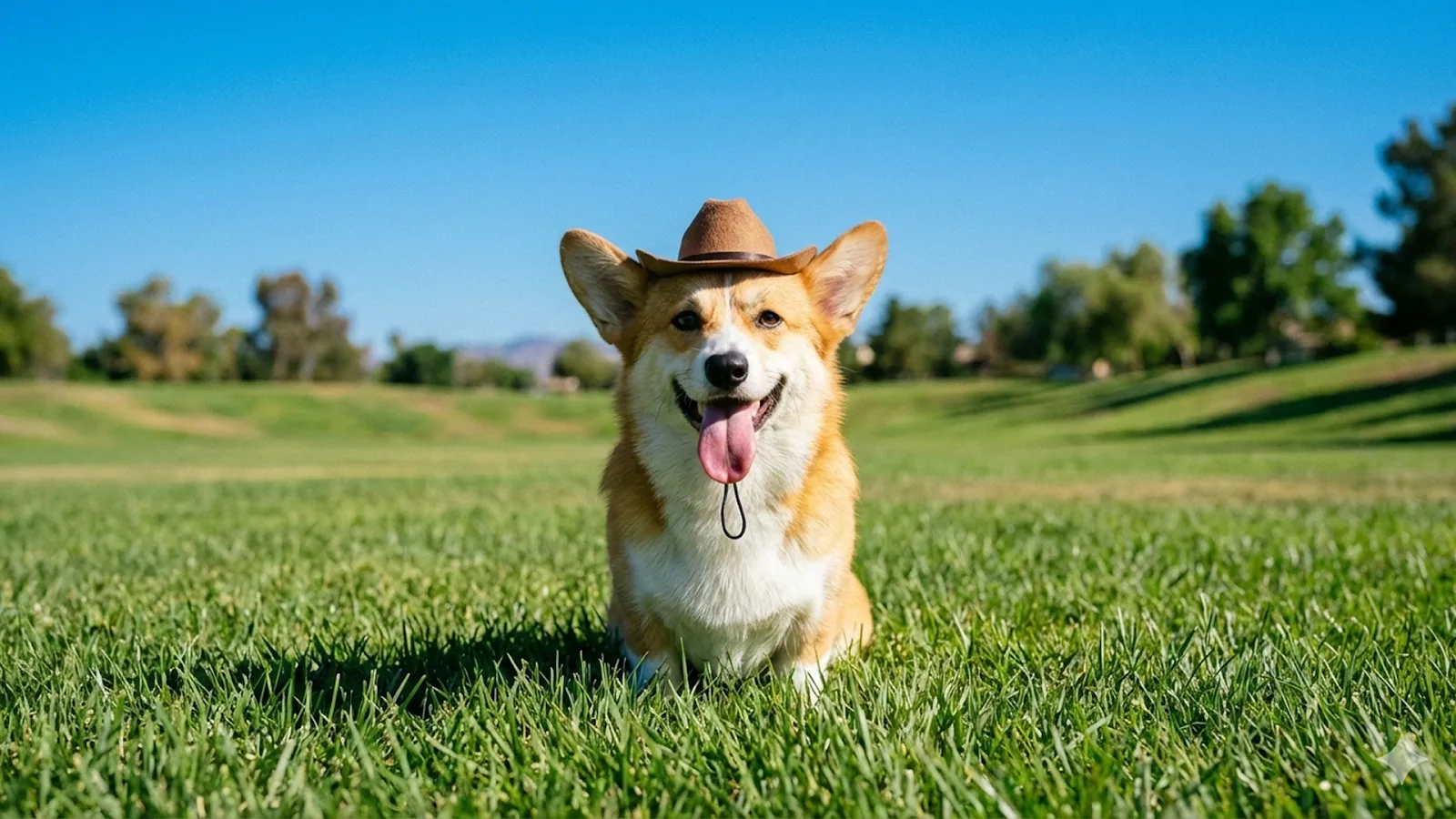
From Google's Gemini image-generation gallery: a photorealistic corgi in a cowboy hat, demonstrating natural light and fur texture at Flash speed.
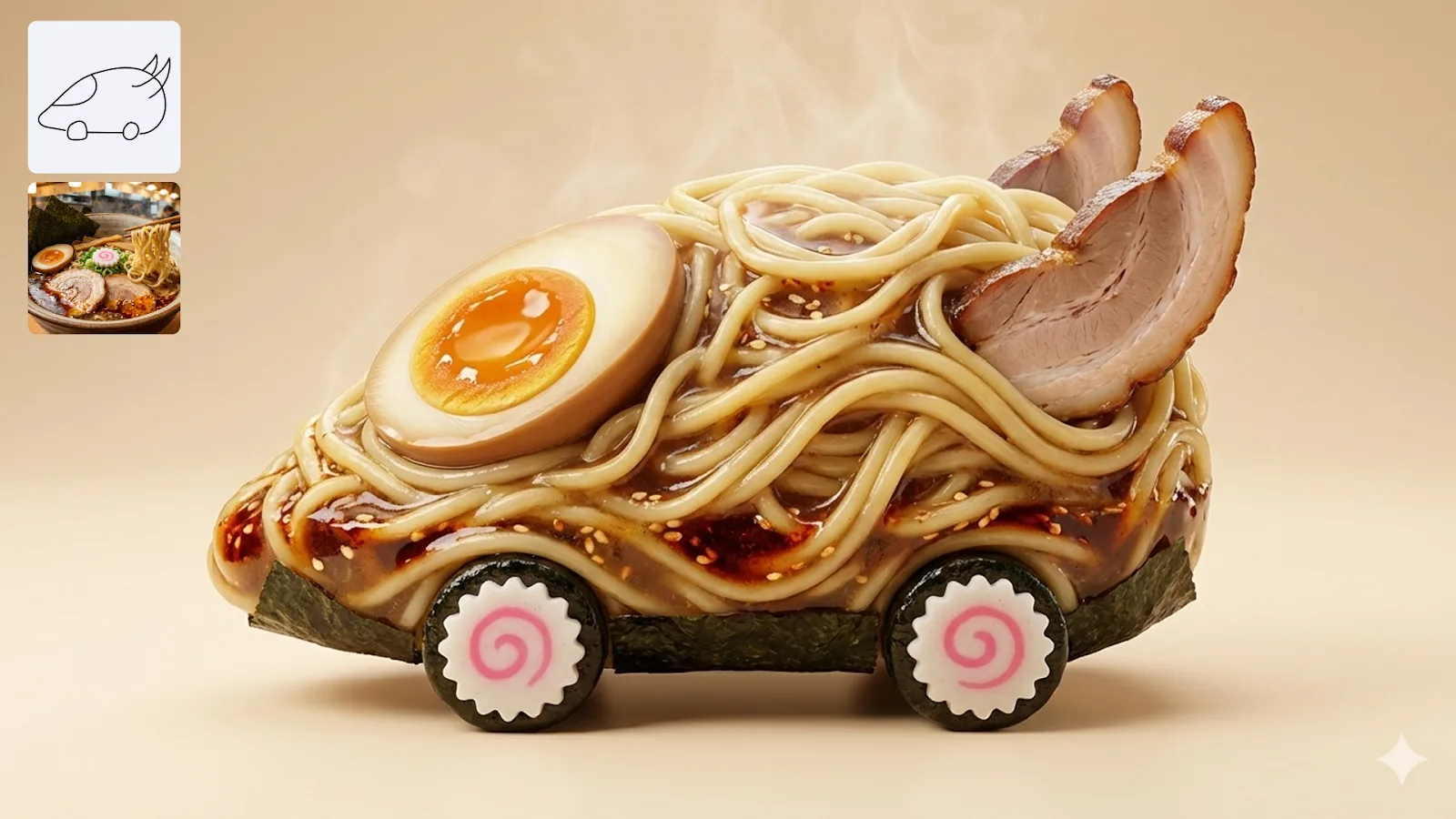
Reference-driven material transfer: the same line sketch of a car re-imagined with ramen as the source material, from Google's style gallery.
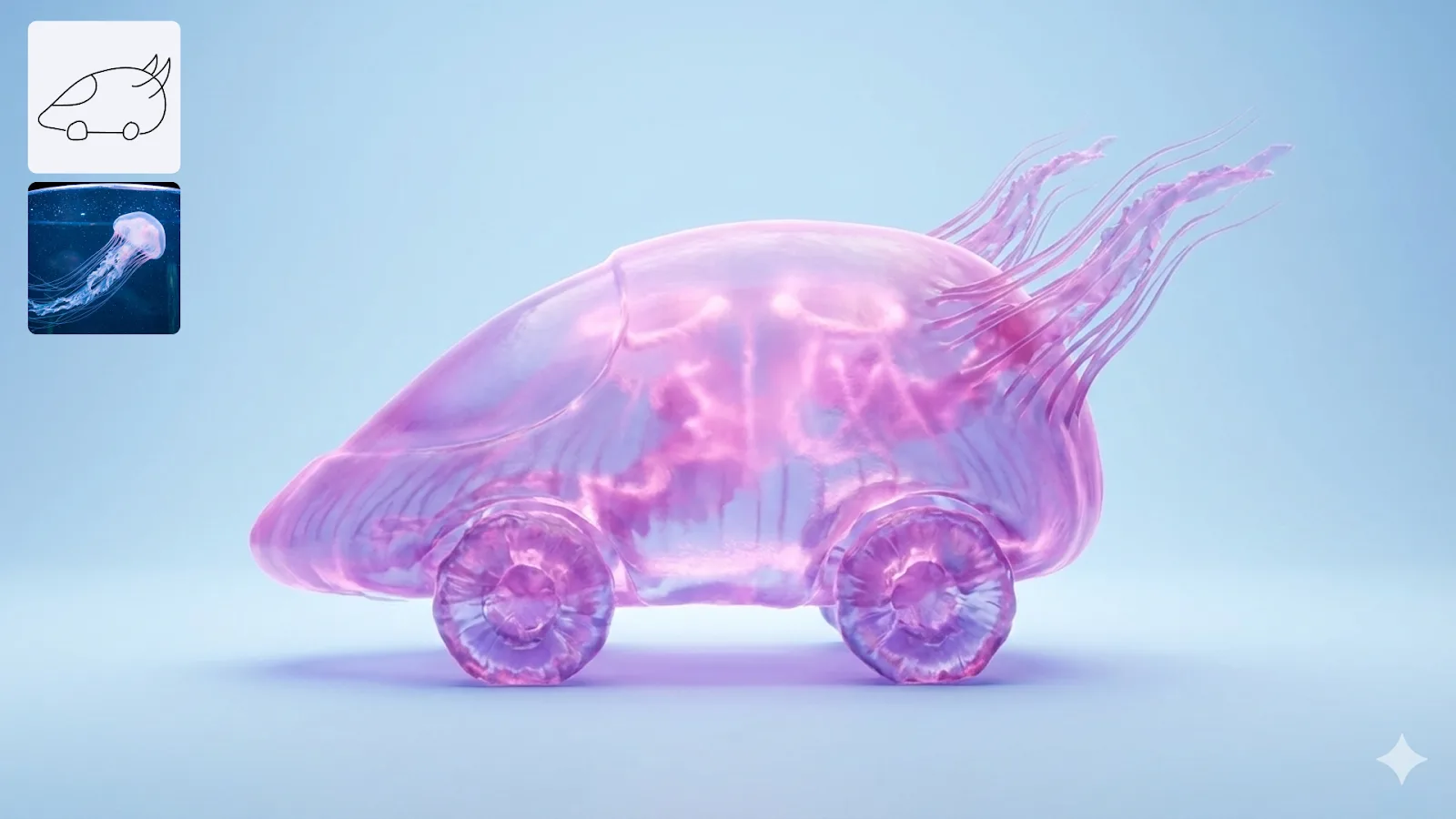
The control case: identical sketch, different reference material — a jellyfish photo instead of ramen. Comparing the two shows how tightly the model follows the reference while keeping the composition fixed.
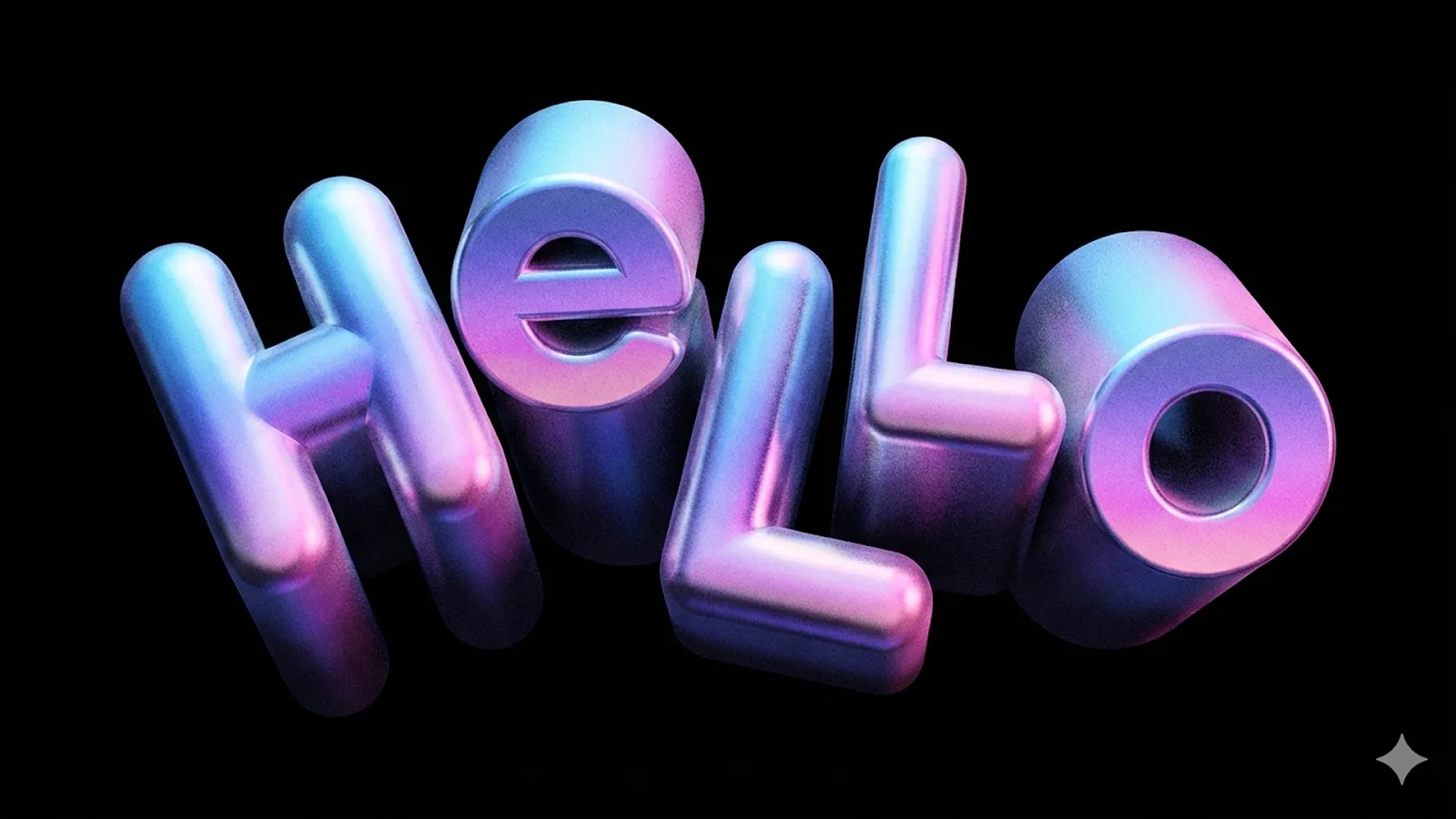
The word "HELLO" as glossy inflated 3D letters, iridescent pink-to-blue gradient chrome, studio reflections, on a pure black background.
Text rendering showcase: HELLO as glossy 3D lettering, the model's signature legible-typography ability.
Nano Banana 2 is Google's Gemini 3.1 Flash Image model (API ID gemini-3.1-flash-image) and the general-purpose member of the four-model Nano Banana family. It previewed on February 26, 2026 and reached general availability on May 28, 2026 alongside Nano Banana Pro. Its pitch is the best of both lineages: Pro-level world knowledge, legible text rendering and multi-character consistency, delivered at Flash speed, with 1K and 2K output generally available, 4K in preview and a new 512 px tier for rapid iteration. Google serves it through the Gemini API and AI Studio (paid key required), Vertex AI for enterprise, Antigravity and Firebase, and in the Gemini app and Search. In this workspace it is served from this site's own runtime catalog, which currently lists image-to-image alongside text-to-image modes.
The documented strengths of the model map onto the editing workflows this workspace exposes. Which modes are callable at any moment is decided by the live catalog.
Draws on Gemini knowledge plus real-time search grounding to render specific subjects, infographics and data visualizations accurately.
Produces legible text for posters, cards and mockups, and can translate and localize text inside an image.
Keeps up to five characters and ten objects faithful within one workflow, per Google, which is what makes storyboards viable.
Adheres strictly to complex, multi-layered prompts; a configurable thinking level lets it reason first on hard briefs.
Native aspect ratios including 4:1, 1:4, 8:1 and 1:8 — fourteen ratios from 1:1 through 21:9 — and resolutions from 512 px to 4K.
Google states every generated image carries C2PA Content Credentials and an invisible SynthID watermark.
Google's own documentation splits the family four ways, and that split is the most useful thing to know before spending a credit. The table quotes what each model is for and what it is not for.
| Model | What it is | Choose it when | Documented limits |
|---|---|---|---|
| Nano Banana 2 Lite (gemini-3.1-flash-lite-image) | Fastest and cheapest family member | Drafting, volume and A/B variants | 1K output; not optimized for multiple reference inputs or multi-turn sequential editing; no search grounding |
| Nano Banana 2 (gemini-3.1-flash-image) | General-purpose workhorse | Everyday generation and editing, 2K–4K, multiple references | 4K is still in preview |
| Nano Banana Pro (gemini-3-pro-image) | Premium tier | Highest world knowledge, advanced localization, brand consistency, precision control | Highest cost; 65,536-token input ceiling |
| Nano Banana (gemini-2.5-flash-image) | Legacy pioneer | Nothing new — Google recommends migrating | Superseded by Nano Banana 2 Lite |
Google's model documentation publishes the technical envelope. Treat it as the model's capability; the workspace may expose a subset per session, and the catalog remains authoritative.
| Specification | Published value |
|---|---|
| Official model ID | gemini-3.1-flash-image |
| Launch stage | Preview February 26, 2026; generally available May 28, 2026 |
| Inputs | Text, images, PDFs, and video (preview) |
| Outputs | Text and images |
| Max input tokens | 131,072 |
| Max output tokens | 32,768 |
| Reference images per prompt | Up to 14 |
| Reference image formats | png, jpeg, webp, heic, heif |
| Document inputs | Up to 50 MB per file via API or Cloud Storage; 7 MB via console upload |
| Aspect ratios | 1:1, 3:2, 2:3, 3:4, 4:3, 4:5, 5:4, 9:16, 16:9, 21:9, plus 1:4, 4:1, 1:8, 8:1 |
| Resolutions | 512 px, 1K, 2K; 4K in preview |
| Search grounding | Supported |
| Knowledge cutoff | January 2025 |
| Content credentials | C2PA Content Credentials and SynthID watermark |
Nano Banana 2 exposes a reasoning control earlier image models did not have: Minimal, the default, renders immediately, while High and Dynamic let the model reason through a prompt before drawing. Google positions this as the main lever between latency and prompt adherence, and it is where long, multi-constraint briefs change the most.
The practical rule: stay on Minimal for volume work, and raise the level when one brief carries several simultaneous constraints — exact text, a fixed layout, and a subject that must stay identical.
Four steps keep image work predictable, whether you start from text or from a reference you are allowed to process.
Two patterns come from Google's own prompting guide for this family. Copy them into the workspace and adapt the bracketed parts.
[subject] [action], in [location or context], [composition: framing, angle, distance], [style: medium, lighting, mood].
Using the attached [sketch] as the structure and the attached [material] as the texture, transform this into a high-fidelity [outcome]. Place it in [new scene].
Three rules from that guide apply to every brief here: describe what you want rather than what you want to avoid — an empty street, not no cars; control the camera with photographic terms such as low angle or aerial view; and iterate in conversation instead of restarting from scratch.
Nano Banana 2 is an image model served from this site's own runtime catalog. It is separate from Google's Gemini 4 Argon text-generation family announced on October 13, 2026: Gemini 4 Argon is a separate chat model and is callable here when the live catalog returns it as available and priced. What you can call today is always what the live catalog returns.
Yes. The current site catalog lists an image-to-image mode alongside text-to-image. The live workspace remains authoritative if availability changes.
The server quote reflects the selected runtime settings, and the completed-task ledger records the final deduction.
No. Nano Banana 2 is the Gemini 3.1 Flash Image model, part of Google's Gemini 3.1 image line. Gemini 4 Argon is Google's newly announced text-generation family, first model Argon; it is callable here through the live catalog.
Google documents accurate, legible text rendering for mockups and cards, plus in-image translation and localization — you can regenerate a sign or poster with its text carried into another language.
Google's announcement cites up to five characters and fourteen objects held faithful within one workflow, which is what makes storyboarding viable.
The model documentation lists resolutions of 512, 1K, 2K and 4K (preview) and fifteen aspect ratios from 1:1 through 21:9, including vertical 9:16 and extreme 1:8. The workspace may expose a subset; the catalog decides.
Google Cloud's documentation allows up to 14 reference images per prompt within a 131,072-token input window.
The model combines Gemini world knowledge with real-time Search grounding, which is why it can render specific subjects and up-to-date visual information more accurately than earlier image models.
January 2025 for Nano Banana 2 and Nano Banana Pro alike, per Google. Anything newer that appears in an image comes from web-search grounding rather than from training data.
Yes. Google states that every generated image includes C2PA Content Credentials and a SynthID watermark. Both travel with the file, so treat them as part of the output when you reuse it.
Follow Google's own split: Lite for speed and volume, Nano Banana 2 as the general-purpose default with 2K–4K output and multiple references, Pro when the highest world knowledge, localization and brand consistency matter. Legacy Nano Banana users are advised to migrate to Lite.