Multimodal input
Accepts text, image, video, audio and PDF inputs; output is text.
 Gemini Link
Gemini 3.8 Flash is Google DeepMind’s high-performance multimodal Flash model for fast reasoning, coding, agentic workflows and long-context tasks.
Build a playable, retro DOS-style version of Google Maps from a single prompt.
In Google's published demonstration inside the Antigravity environment, Gemini 3.8 Flash produced a working, playable DOS-style take on Google Maps from one prompt, one of several single-shot build demos (a game and a terrain visualizer built on USGS data) that Google used to illustrate its agentic coding gains.
Single-prompt build demonstration recorded in Google's announcement. This is a vendor-documented result, not a benchmark run on this site.
Google DeepMind released Gemini 3.8 Flash on September 2, 2026 as its most intelligent Flash model in generally available form, positioned for long-horizon software engineering, autonomous agents and complex enterprise workflows. It keeps the speed-and-cost profile of Gemini 3.7 Flash while improving on every published benchmark, and Google describes the design as "works harder": on hard tasks it runs extra reasoning passes and iterates with tools, which can use more tokens per task in exchange for a higher success rate. In this workspace it appears as a callable, priced chat mode; runtime capabilities and the server quote remain authoritative.
The Gemini API lists a broad capability set for this model. Which controls this workspace exposes at any moment is decided by the live catalog, so treat the cards below as the model's documented abilities rather than a promise about every session's options.
These figures are Google's published API prices, not this site's charges. What you pay here is always determined by the server quote before submission and the task ledger after completion.
Accepts text, image, video, audio and PDF inputs; output is text.
Low, medium and high effort are supported. Minimal thinking is not supported on this model.
Function calling, tool use, structured outputs and server-side code execution.
Search grounding and URL context let the model cite live sources.
The 1M-token window fits document-heavy and multi-file engineering tasks.
Built for agent loops, with computer use available in preview.
Google's announcement includes a side-by-side evaluation table against Gemini 3.7 Flash and competing frontier models. Highlights: 73.7% on DeepSWE v1.1 for long-horizon software engineering (Claude Opus 5: 74.0%, GPT-5.6 Sol: 72.7%), 89.4% on Terminal-Bench 2.1 for agentic terminal coding, and clear gains over 3.7 Flash on finance and legal agent benchmarks. These are vendor-reported results published with Google's evaluation methodology, not independent audits and not tests run on this site.
| Benchmark | What it measures | Gemini 3.8 Flash | Gemini 3.7 Flash | Claude Opus 5 | GPT-5.6 Sol |
|---|---|---|---|---|---|
| DeepSWE v1.1 | Long-horizon software engineering | 73.7% | 65.3% | 74.0% | 72.7% |
| Terminal-Bench 2.1 | Agentic terminal coding | 89.4% | 85.8% | 89.1% | 88.8% |
| Vals Finance Agent v2 | Financial analyst tasks | 61.4% | 59.0% | 58.6% | 53.8% |
| Harvey's Legal Agent Benchmark | Complex legal workflows | 10.0% | 8.8% | 6.7% | 2.5% |
| HLE-Verified | Multidisciplinary expert reasoning | 54.9% | 53.6% | 54.4% | 54.5% |
| CharXiv Reasoning | Synthesis from complex charts | 86.2% | 84.5% | 83.7% | 85.8% |
| LVBench | Long video understanding | 87.1% | 85.4% | 75.4% | 82.1% |
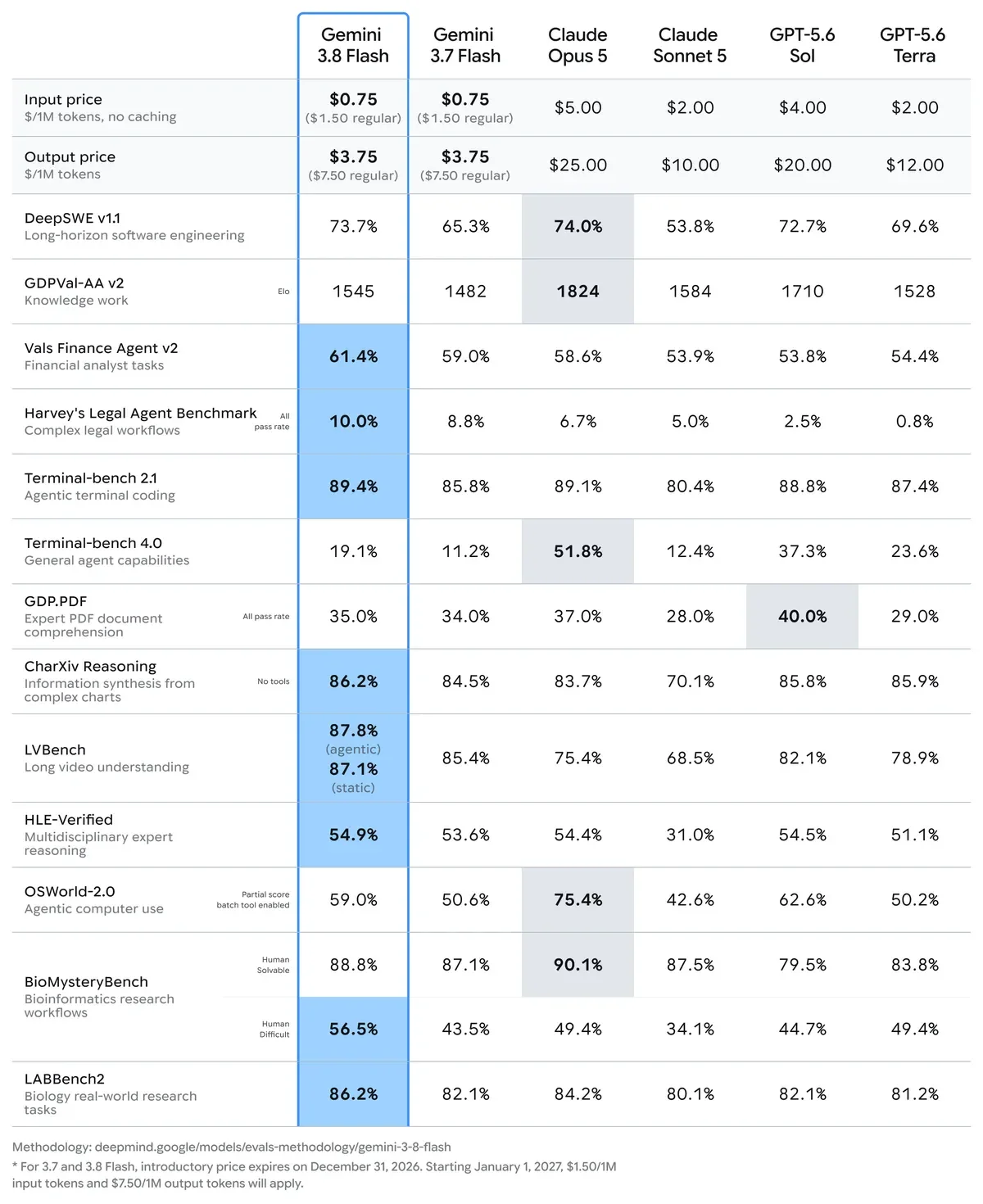
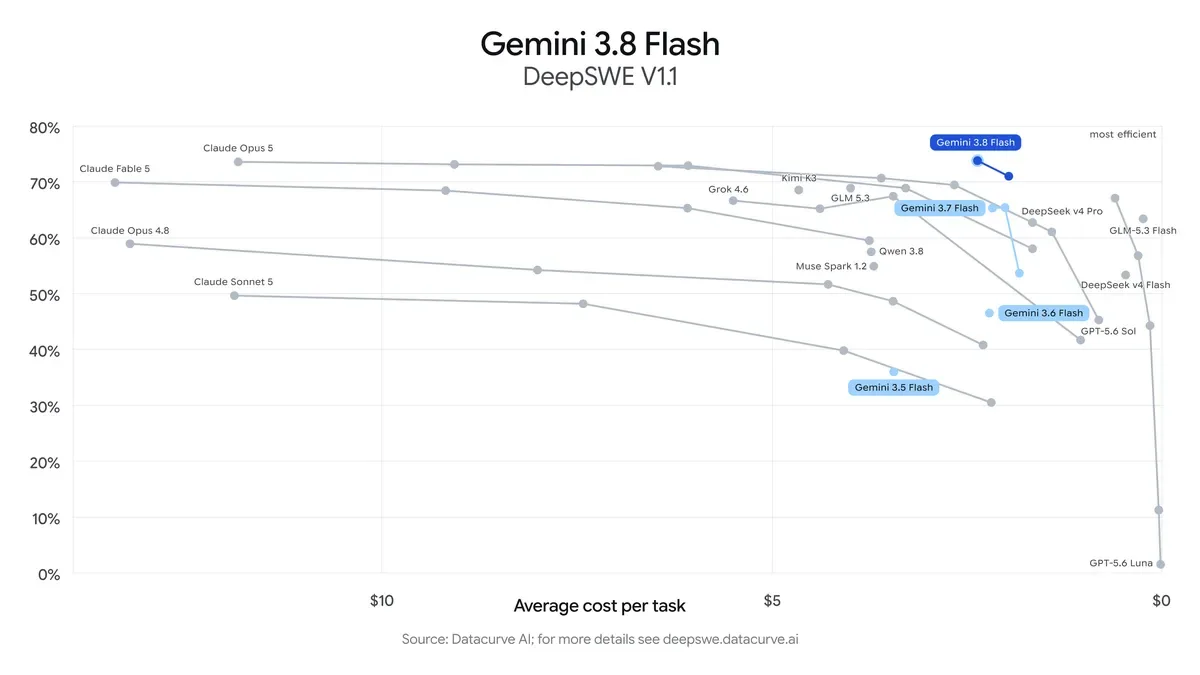
Both figures reproduce Google's published evaluation materials for Gemini 3.8 Flash; methodology notes are included in the original announcement. blog.google ↗
The chat workspace on this site calls Gemini 3.8 Flash as a priced mode from the live catalog. Four habits keep sessions predictable.
Two patterns exploit what this model was built for: extra reasoning passes on hard tasks, and long-context synthesis. Copy them into the workspace and adapt the bracketed parts.
Read the attached document end to end. Extract every [clause / metric / deadline] that matches the rule below, list them in document order with the section they came from, and flag any conflict between sections. Rule: [your rule].
Implement [feature] in [repository/file]. First list the files you need to touch and the order of changes, then make each change, then summarize how to verify the result. If any step depends on an assumption, state the assumption before coding.
Because the model can spend more reasoning tokens on hard tasks, watch the quote on exploratory work: lowering the thinking level, or splitting a large task into reviewable steps, usually trims cost without hurting the outcome.
Gemini 4 Argon, Google's new frontier model, opened worldwide through the Gemini API and subscription channels on October 13, 2026. Its introductory API price is $2 / $10 per million tokens; Gemini 3.8 Flash keeps the Flash tier at $0.75 / $3.75. This workspace calls Gemini 3.8 Flash today. Argon appears here only when the runtime catalog lists it as callable and priced.
No. Gemini 4 Argon is the site name; this page opens the Gemini 3.8 Flash chat mode currently available on this site.
The server quote provides the estimate and the server ledger records actual usage.
Gemini 4 Argon is officially available. This workspace calls it in this workspace when the live catalog returns gemini-4-argon-chat as available, callable and priced.
There is no schedule. A model appears here only when the site operator enables it and the runtime catalog lists it as callable and priced for this site.
Google publishes a 1,048,576-token input window with up to 65,536 output tokens, and a March 2026 knowledge cutoff. The workspace may cap visible length per session; the live catalog is authoritative for what a session exposes.
Google's API lists an introductory $0.75 per million input tokens and $3.75 per million output tokens through December 31, 2026, doubling to $1.50 and $7.50 on January 1, 2027. Charges inside this workspace are set by the server quote and settled in the task ledger, which may differ from Google's list price.
The Gemini API accepts text, image, video, audio and PDF inputs for this model and returns text. Which input types are enabled in this workspace depends on the live catalog; check the controls shown in the session.
A companion variant tuned for vulnerability discovery and patching, announced the same day. Google distributes it to vetted defenders through the Fairwind Program rather than the general API, so it is not the model this page serves.
Chat with Gemini 4 Argon through this site's live catalog, with multimodal input, required reasoning and a server quote before every request.
Gemini 3.7 Flash guide: official specs, Google API pricing, deprecation status, 1M context, published benchmarks and chat workspace access.
Short guides for the Gemini 4 Argon workspace: prepare a useful brief, choose a model by capability, review the server quote, and check the result against the ledger.
Use Gemini 4 Argon online for coding, research and multimodal document work. See its official 1M-token context, benchmarks and live site pricing.